Triglycerides mmol/L to mg/dL: Complete Conversion Guide
Convert triglycerides from mmol/L to mg/dL with the 88.57 conversion factor. Includes quick tables, clinical categories, and fasting lipid panel context.
Quick Answer
To convert triglycerides from mmol/L to mg/dL, multiply by 88.57.
| mmol/L | mg/dL | Common Category |
|---|---|---|
| 1.0 | 89 | Normal |
| 1.7 | 151 | Borderline High |
| 2.3 | 204 | High |
| 5.6 | 496 | High, near very high |
| 5.7 | 505 | Very High |
1.7 mmol/L = 30.6 mg/dL
Borderline triglycerides threshold
Triglycerides Converter
From: mmol/L
Result
99.1mg/dL
Use the triglycerides option in the converter. Triglycerides use a different conversion factor from cholesterol, LDL, and HDL. Do not use the cholesterol factor of 38.67 for triglycerides.
Key Takeaways
Summary:
Point Fact Conversion factor 1 mmol/L = 88.57 mg/dL Reverse formula mg/dL ÷ 88.57 = mmol/L Common normal cutoff Below 150 mg/dL, about below 1.7 mmol/L Very high cutoff 500 mg/dL or higher, about 5.7 mmol/L or higher Interpretation Triglycerides are interpreted as part of a lipid panel, not as a diagnosis by themselves
Triglycerides Conversion Formula
Triglycerides are measured in two common unit systems:
- mmol/L: millimoles per liter, common in countries using SI units.
- mg/dL: milligrams per deciliter, common in the United States.
The conversion used on this site is:
| Direction | Formula |
|---|---|
| mmol/L to mg/dL | mmol/L × 88.57 |
| mg/dL to mmol/L | mg/dL ÷ 88.57 |
The factor is different from cholesterol because triglycerides are a different class of molecules. This site uses 88.57 for triglycerides and 38.67 for total cholesterol, LDL, and HDL.
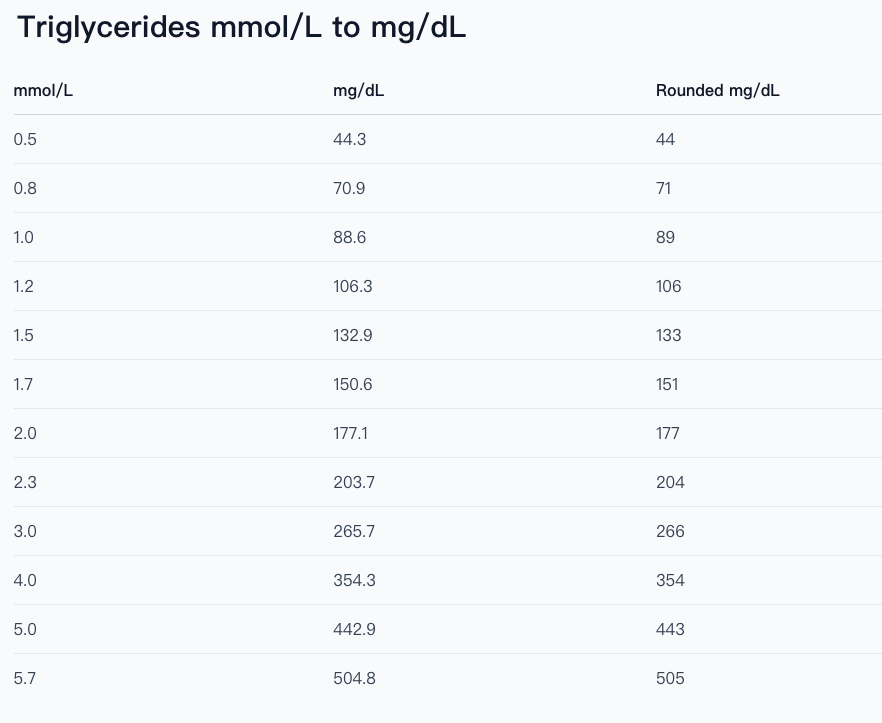
Triglycerides mmol/L to mg/dL
| mmol/L | mg/dL | Rounded mg/dL |
|---|---|---|
| 0.5 | 44.3 | 44 |
| 0.8 | 70.9 | 71 |
| 1.0 | 88.6 | 89 |
| 1.2 | 106.3 | 106 |
| 1.5 | 132.9 | 133 |
| 1.7 | 150.6 | 151 |
| 2.0 | 177.1 | 177 |
| 2.3 | 203.7 | 204 |
| 3.0 | 265.7 | 266 |
| 4.0 | 354.3 | 354 |
| 5.0 | 442.9 | 443 |
| 5.7 | 504.8 | 505 |
Triglycerides Categories
The following categories are commonly used in patient education and lipid panel interpretation.
| Category | mg/dL | mmol/L |
|---|---|---|
| Normal | < 150 | < 1.7 |
| Borderline High | 150-199 | 1.7-2.2 |
| High | 200-499 | 2.3-5.6 |
| Very High | ≥ 500 | ≥ 5.7 |
These ranges describe triglyceride concentration. They do not diagnose a condition by themselves. Clinicians interpret triglycerides together with LDL, HDL, total cholesterol, medical history, medications, and cardiovascular risk.
Fasting vs. Non-Fasting Triglycerides
Triglycerides can change after meals. A lipid panel may be fasting or non-fasting depending on the clinical situation and local practice.
| Test Context | What It Means |
|---|---|
| Fasting lipid panel | Measured after a fasting period requested by a clinician or lab |
| Non-fasting lipid panel | Measured without fasting; triglycerides may be influenced by recent food intake |
| Repeat testing | May be used when a value needs confirmation or clinical follow-up |
If your result was not fasting, use the converted value as a unit conversion only. Ask your healthcare provider how to interpret it.
Triglycerides vs. Cholesterol Conversion
| Marker | Conversion Factor | Example |
|---|---|---|
| Triglycerides | mmol/L × 88.57 | 1.7 mmol/L = 151 mg/dL |
| Total Cholesterol | mmol/L × 38.67 | 5.2 mmol/L = 201 mg/dL |
| LDL Cholesterol | mmol/L × 38.67 | 2.6 mmol/L = 101 mg/dL |
| HDL Cholesterol | mmol/L × 38.67 | 1.6 mmol/L = 62 mg/dL |
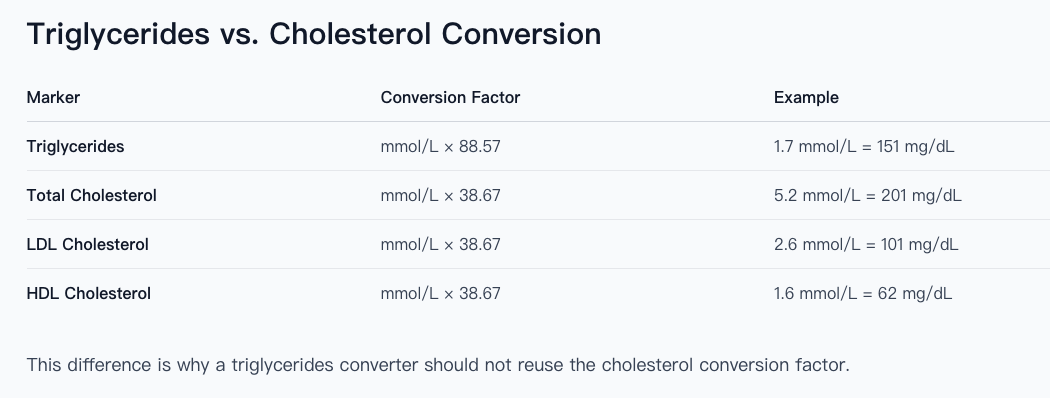
This difference is why a triglycerides converter should not reuse the cholesterol conversion factor.
FAQ
What is the triglycerides mmol/L to mg/dL formula?
Use mg/dL = mmol/L × 88.57.
For example, 1.7 mmol/L × 88.57 = 150.6 mg/dL, usually rounded to 151 mg/dL.
Is 1.7 mmol/L triglycerides normal?
1.7 mmol/L is approximately 151 mg/dL. That is around the common borderline high cutoff for triglycerides.
What is 2.3 mmol/L triglycerides in mg/dL?
2.3 mmol/L equals 203.7 mg/dL, usually rounded to 204 mg/dL.
What is 5.7 mmol/L triglycerides in mg/dL?
5.7 mmol/L equals 504.8 mg/dL, usually rounded to 505 mg/dL. This is around the common very high triglycerides cutoff.
Why is triglycerides conversion different from cholesterol?
Triglycerides and cholesterol are different substances. Triglycerides use the 88.57 factor, while total cholesterol, LDL, and HDL use 38.67.
Can this page interpret my lipid panel?
No. This page converts units and explains common reference categories. A lipid panel should be interpreted by a qualified healthcare professional.
Related Resources
- Triglycerides mg/dL to mmol/L - Reverse triglycerides conversion
- Cholesterol mmol/L to mg/dL - Total cholesterol, LDL, HDL, and lipid panel guide
- LDL Cholesterol mmol/L to mg/dL - LDL-specific conversion and targets
- HDL Cholesterol mmol/L to mg/dL - HDL-specific conversion and ranges
References
- Mayo Clinic. Cholesterol test
- American Heart Association. What Your Cholesterol Levels Mean
- Centers for Disease Control and Prevention. About Cholesterol
- National Heart, Lung, and Blood Institute. Blood Cholesterol
Medical Disclaimer: This page is for unit conversion and general education only. Triglyceride values should be interpreted by a healthcare professional in the context of your complete lipid panel and health history.