Cholesterol mmol/L to mg/dL: Complete Conversion Guide
Convert cholesterol levels between mmol/L and mg/dL instantly. Free online calculator for Total, LDL, HDL cholesterol with normal ranges and conversion formulas.
Understanding Cholesterol Units
Cholesterol levels are measured using two different unit systems around the world. Understanding both is essential when reading lab results from different countries or medical literature.
What is mmol/L?
Millimoles per liter (mmol/L) is the SI (International System of Units) measurement used in most countries worldwide:
- United Kingdom
- Canada
- Australia
- Europe
- Most of Asia
- New Zealand
This unit measures the concentration of cholesterol in terms of the number of molecules (in millimoles) per liter of blood.
What is mg/dL?
Milligrams per deciliter (mg/dL) is the traditional unit primarily used in:
- United States
- Some Latin American countries
- A few other regions
This unit measures the weight of cholesterol (in milligrams) per deciliter (100 milliliters) of blood.
The Conversion Formula
Why multiply by 38.67?
The conversion between mmol/L and mg/dL is based on the molecular weight of cholesterol (C₂₇H₄₆O), which is approximately 386.65 g/mol:
- 1 mole of cholesterol = 386.65 grams
- 1 millimole (mmol) = 386.65 milligrams
- 1 liter = 10 deciliters
Therefore: 1 mmol/L = (386.65 mg / 10 dL) = 38.67 mg/dL
Conversion Formulas
| From | To | Formula |
|---|---|---|
| mmol/L | mg/dL | Multiply by 38.67 |
| mg/dL | mmol/L | Divide by 38.67 (or multiply by 0.02586) |
Quick Examples
| mmol/L | mg/dL | Health Category |
|---|---|---|
| 3.8 | 147 | Optimal |
| 5.0 | 193 | Desirable (WHO standard) |
| 5.2 | 201 | Desirable/Normal upper limit |
| 6.2 | 240 | Borderline/High threshold |
Cholesterol Converter
From: mmol/L
Result
99.1mg/dL
Critical Cholesterol Values Explained
Understanding key cholesterol values can help you interpret your test results:
5.2 mmol/L (200 mg/dL) - Desirable Upper Limit
This is the desirable upper limit for total cholesterol. Levels below 5.2 mmol/L (200 mg/dL) are generally considered healthy for adults.
6.2 mmol/L (240 mg/dL) - High Cholesterol Threshold
This is the threshold for high cholesterol. At or above this level, your risk of heart disease significantly increases.
2.6 mmol/L (100 mg/dL) - LDL Optimal Target
This is the optimal LDL (bad cholesterol) target for healthy adults. Keeping LDL below this level reduces cardiovascular risk.
1.8 mmol/L (70 mg/dL) - LDL Target for High-Risk Patients
For people with heart disease, diabetes, or high cardiovascular risk, this is the recommended LDL target. Some very high-risk patients may need even lower targets (1.4 mmol/L / 55 mg/dL).
1.6 mmol/L (60 mg/dL) - Protective HDL Level
HDL cholesterol at or above this level is considered protective against heart disease. Higher HDL is generally better.
1.0 mmol/L (40 mg/dL) - Low HDL Threshold
HDL below this level (1.0 mmol/L for men, 1.2 mmol/L for women) is considered a risk factor for heart disease.
Cholesterol Types Explained
Your lipid profile includes several types of cholesterol. All use the same conversion factor (38.67) because they're all forms of cholesterol.
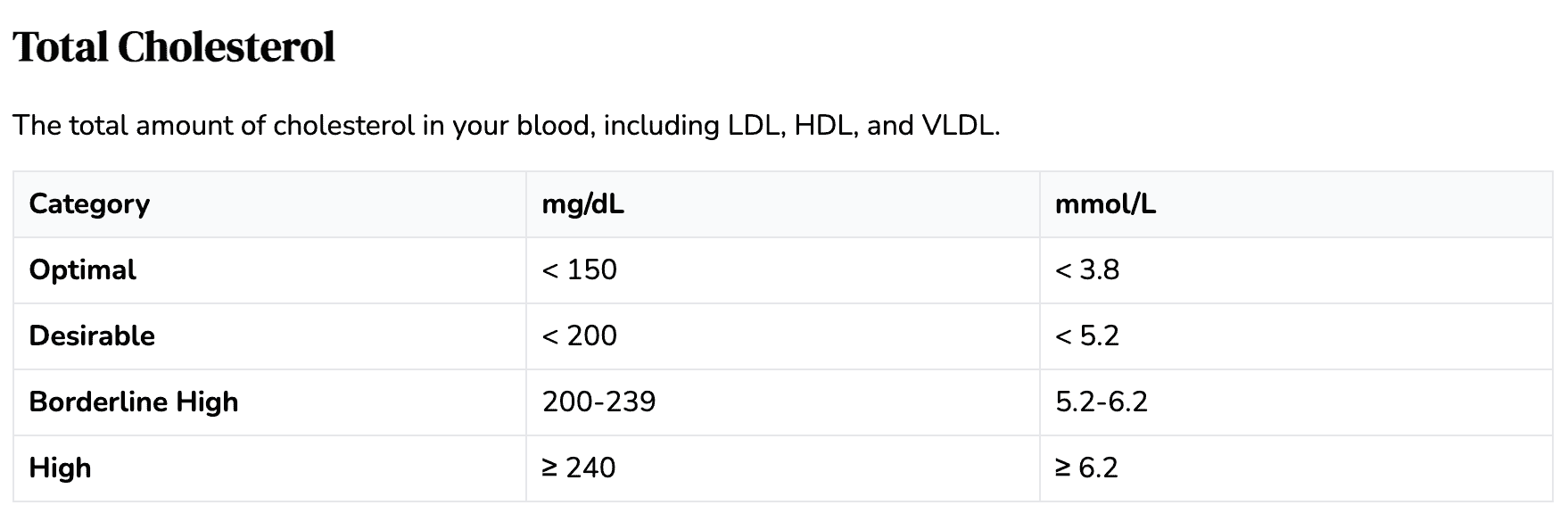
Total Cholesterol
The total amount of cholesterol in your blood, including LDL, HDL, and VLDL.
| Category | mg/dL | mmol/L |
|---|---|---|
| Optimal | < 150 | < 3.8 |
| Desirable | < 200 | < 5.2 |
| Borderline High | 200-239 | 5.2-6.2 |
| High | ≥ 240 | ≥ 6.2 |
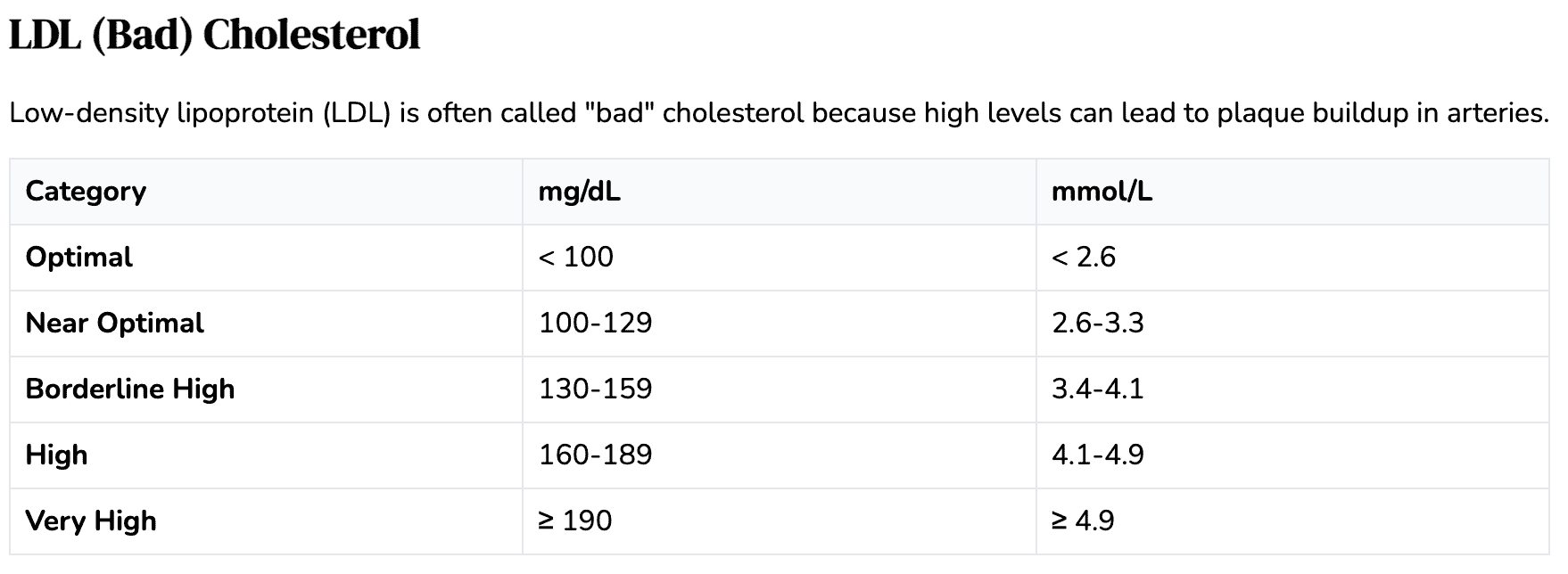
LDL (Bad) Cholesterol
Low-density lipoprotein (LDL) is often called "bad" cholesterol because high levels can lead to plaque buildup in arteries.
| Category | mg/dL | mmol/L |
|---|---|---|
| Optimal | < 100 | < 2.6 |
| Near Optimal | 100-129 | 2.6-3.3 |
| Borderline High | 130-159 | 3.4-4.1 |
| High | 160-189 | 4.1-4.9 |
| Very High | ≥ 190 | ≥ 4.9 |
For high-risk patients (heart disease, diabetes):
- Target: < 70 mg/dL (< 1.8 mmol/L)
- Very high risk: < 55 mg/dL (< 1.4 mmol/L)
💡 Learn more: For detailed LDL conversion, normal ranges, foods that lower LDL, and treatment options, see our comprehensive LDL Cholesterol Guide.
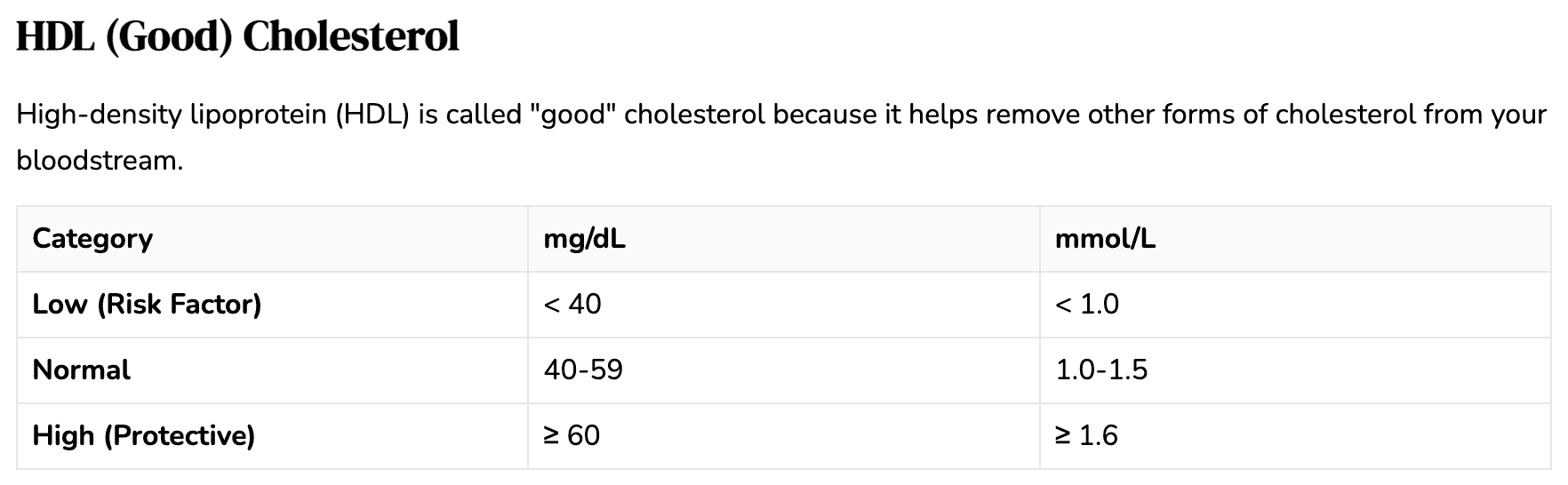
HDL (Good) Cholesterol
High-density lipoprotein (HDL) is called "good" cholesterol because it helps remove other forms of cholesterol from your bloodstream.
| Category | mg/dL | mmol/L |
|---|---|---|
| Low (Risk Factor) | < 40 | < 1.0 |
| Normal | 40-59 | 1.0-1.5 |
| High (Protective) | ≥ 60 | ≥ 1.6 |
Gender differences:
- Men: HDL should be > 40 mg/dL (> 1.0 mmol/L)
- Women: HDL should be > 50 mg/dL (> 1.2 mmol/L)
Why HDL is protective:
- Acts as a "cholesterol scavenger" - picks up excess cholesterol from tissues
- Transports cholesterol back to the liver for elimination (reverse cholesterol transport)
- Has antioxidant and anti-inflammatory properties
- Helps maintain endothelial function (blood vessel health)
What affects HDL levels:
| Factor | Effect on HDL |
|---|---|
| Exercise | Increases HDL |
| Smoking | Decreases HDL |
| Trans fats | Decreases HDL |
| Healthy fats (olive oil, fish) | Increases HDL |
| Excess weight | Decreases HDL |
| Genetics | Can cause very high or very low HDL |
Non-HDL Cholesterol
Calculated as: Total Cholesterol - HDL
Non-HDL cholesterol represents all the "bad" cholesterol types in your blood:
- LDL (bad cholesterol)
- VLDL (very low-density lipoprotein)
- IDL (intermediate-density lipoprotein)
- Remnant lipoproteins
| Category | mg/dL | mmol/L |
|---|---|---|
| Optimal | < 130 | < 3.4 |
| Near Optimal | 130-159 | 3.4-4.1 |
| Borderline High | 160-189 | 4.1-4.9 |
| High | 190-219 | 4.9-5.7 |
| Very High | ≥ 220 | ≥ 5.7 |
Why Non-HDL is increasingly important:
- Captures all atherogenic (plaque-causing) particles
- Better predictor of cardiovascular risk than LDL alone
- Particularly useful for people with:
- High triglycerides
- Diabetes
- Metabolic syndrome
Target principle: Your non-HDL goal should be approximately 30 mg/dL higher than your LDL goal.
| LDL Target (mg/dL) | Non-HDL Target (mg/dL) |
|---|---|
| < 100 (optimal) | < 130 |
| < 70 (high risk) | < 100 |
| < 55 (very high risk) | < 85 |
VLDL (Very Low-Density Lipoprotein)
Often estimated as: Triglycerides ÷ 5
| Category | mg/dL |
|---|---|
| Normal | < 30 |
What to Test and When
Should You Test Total Cholesterol or LDL?
The answer: Both, but they serve different purposes.
| Test | What It Shows | When to Use | Frequency |
|---|---|---|---|
| Total Cholesterol | Overall cholesterol picture | Initial screening | Every 5 years (if normal) |
| LDL Cholesterol | "Bad" cholesterol specifically | Risk assessment, treatment monitoring | As needed based on risk |
| HDL Cholesterol | "Good" cholesterol | Complete lipid profile | Part of lipid panel |
| Non-HDL | All "bad" cholesterol | Better risk predictor | Part of lipid panel |
Testing Scenarios
For healthy adults under 40:
- Start with total cholesterol screening
- If total cholesterol is normal, no further testing needed
- If elevated, request complete lipid panel
For adults 40-65:
- Complete lipid panel annually
- Includes total cholesterol, LDL, HDL, triglycerides
- Track trends over time
For high-risk individuals:
- Complete lipid panel every 3-6 months
- Focus on LDL and non-HDL for treatment decisions
- Monitor response to diet/exercise/medication
Understanding Your Results
What your provider looks at:
| Scenario | Focus Area | Why |
|---|---|---|
| First-time screening | Total cholesterol | Quick assessment |
| Elevated total cholesterol | LDL, non-HDL | Identify cause |
| Treatment monitoring | LDL, non-HDL | Track improvement |
| High triglycerides | Non-HDL | Better risk predictor |
| Diabetes | LDL, non-HDL | Stricter targets |
💡 Tip: Always review your complete lipid profile with a healthcare provider who can interpret all values together in the context of your overall health.
Understanding Your Lipid Panel
What's Included in a Complete Lipid Profile?
- Total Cholesterol
- LDL Cholesterol (calculated or direct)
- HDL Cholesterol (measured)
- Triglycerides (measured)
- VLDL (often calculated)
- Non-HDL Cholesterol (calculated)
- Total Cholesterol to HDL Ratio (calculated)
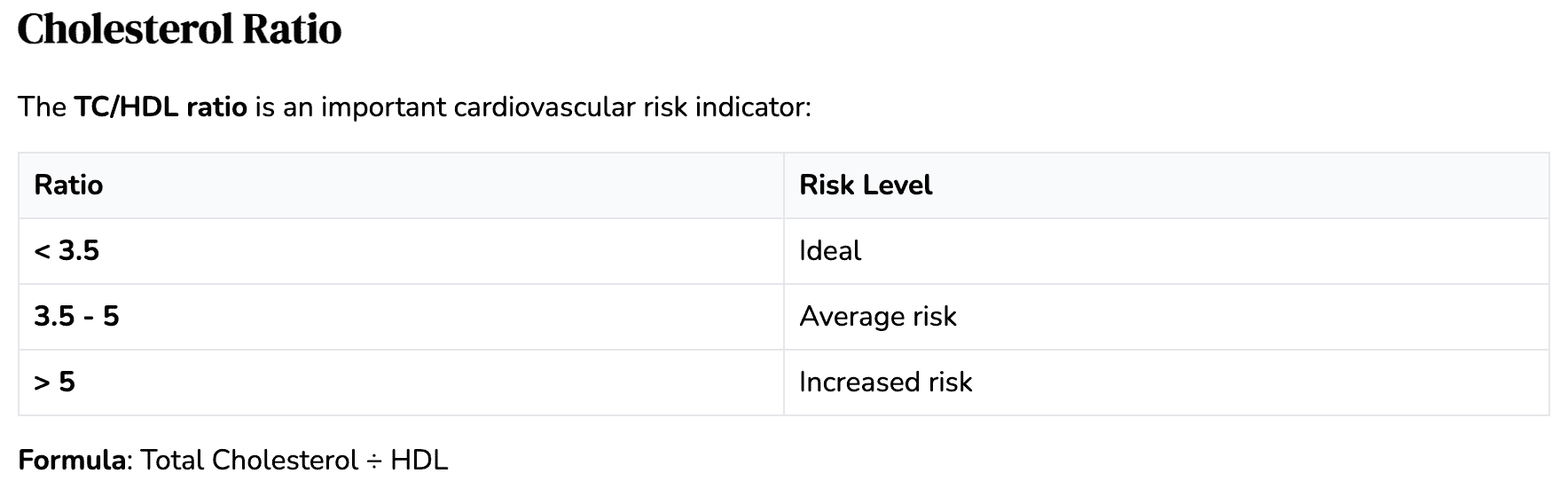
Cholesterol Ratio
The TC/HDL ratio is an important cardiovascular risk indicator:
| Ratio | Risk Level |
|---|---|
| < 3.5 | Ideal |
| 3.5 - 5 | Average risk |
| > 5 | Increased risk |
Formula: Total Cholesterol ÷ HDL
How Often Should You Test?
| Age | Testing Frequency |
|---|---|
| 20-45 | Every 5 years (if normal) |
| 45-65 | Every 1-2 years |
| 65+ | Every year |
| High Risk | As recommended by doctor |
Calculated Values
Friedewald Formula for LDL
LDL is often calculated rather than directly measured:
For mg/dL:
LDL = Total Cholesterol - HDL - (Triglycerides ÷ 5)
For mmol/L:
LDL = Total Cholesterol - HDL - (Triglycerides ÷ 2.2)
Limitations:
- Not accurate when triglycerides exceed 400 mg/dL (4.5 mmol/L)
- Less accurate at very low LDL levels (< 70 mg/dL)
When to Use This Converter
Common Use Cases
-
Reading Lab Results
- Converting results from different laboratories
- Understanding international reference ranges
-
Medical Research
- Comparing data from studies using different units
- Reviewing international clinical guidelines
-
Travel or Relocation
- Understanding lab results from different countries
- Communicating with healthcare providers abroad
-
Health Tracking
- Monitoring progress using different measurement systems
- Sharing results with international specialists
FAQ
What is 5.2 mmol/L to mg/dL?
5.2 mmol/L = 201 mg/dL (approximately 200 mg/dL)
This is the desirable upper limit for total cholesterol according to the American Heart Association. Levels below 5.2 mmol/L (200 mg/dL) are generally considered healthy.
What is 200 mg/dL to mmol/L?
200 mg/dL = 5.17 mmol/L (approximately 5.2 mmol/L)
This is the threshold between desirable and borderline high total cholesterol.
What is 100 mg/dL to mmol/L for cholesterol?
100 mg/dL = 2.6 mmol/L (for cholesterol)
For LDL cholesterol, 100 mg/dL (2.6 mmol/L) is the optimal target for healthy adults.
For total cholesterol, 100 mg/dL would be very low - the optimal total cholesterol range is below 200 mg/dL (5.2 mmol/L).
💡 Learn more: See our LDL Cholesterol Guide for detailed LDL targets, ranges, and conversion.
What is 8.2 mmol/L to mg/dL?
8.2 mmol/L = 317 mg/dL
This is a very high total cholesterol level, significantly above the desirable range (< 5.2 mmol/L or 200 mg/dL). If your cholesterol is this high, consult your healthcare provider for evaluation and management.
Why is cholesterol conversion different from glucose conversion?
Different substances have different molecular weights, which determines the conversion factor:
| Substance | Molecular Weight | Conversion Factor |
|---|---|---|
| Glucose | 180.18 g/mol | 18.018 |
| Cholesterol | 386.65 g/mol | 38.67 |
| Triglycerides | 885.7 g/mol | 88.57 |
Which cholesterol number is most important?
It depends on your overall health:
- For most people: LDL is the primary target - see our LDL Cholesterol Guide for detailed information
- For comprehensive assessment: Healthcare providers look at the complete lipid profile
- Non-HDL cholesterol is increasingly used as a treatment target
- Total cholesterol to HDL ratio provides additional risk context
Key point: While LDL is usually the main focus, your healthcare provider will consider all values together to assess your overall cardiovascular risk.
What is non-HDL cholesterol?
Non-HDL = Total Cholesterol - HDL
This represents all the "bad" cholesterol types (LDL + VLDL + IDL). It's considered a better predictor of cardiovascular risk than LDL alone, especially for people with high triglycerides.
Target: Your non-HDL goal should be about 30 mg/dL higher than your LDL goal.
What is a good total cholesterol to HDL ratio?
The cholesterol ratio (Total Cholesterol ÷ HDL) is an important cardiovascular risk indicator:
| Ratio | Risk Level | Meaning |
|---|---|---|
| < 3.5 | Ideal | Low cardiovascular risk |
| 3.5 - 5 | Average risk | Moderate risk |
| > 5 | Increased risk | Higher cardiovascular risk |
Example calculations:
- Total cholesterol 200 mg/dL ÷ HDL 50 mg/dL = 4.0 (average risk)
- Total cholesterol 200 mg/dL ÷ HDL 60 mg/dL = 3.3 (ideal)
Why the ratio matters: A high ratio indicates you may have too much "bad" cholesterol relative to "good" cholesterol, even if your total cholesterol is in the normal range.
What is HDL cholesterol and why is it important?
HDL (High-Density Lipoprotein) is called "good" cholesterol because it removes excess cholesterol from your tissues and transports it back to the liver for elimination.
Why HDL matters:
- Acts as a "cholesterol scavenger" - cleans up excess cholesterol
- Higher HDL is associated with lower heart disease risk
- Low HDL is a risk factor even if total cholesterol is normal
HDL targets:
- Men: > 40 mg/dL (> 1.0 mmol/L)
- Women: > 50 mg/dL (> 1.2 mmol/L)
- Protective: ≥ 60 mg/dL (≥ 1.6 mmol/L) for both sexes
What affects HDL:
- Increases HDL: Exercise, healthy fats (olive oil, fish), quitting smoking
- Decreases HDL: Smoking, trans fats, excess weight, sedentary lifestyle
- Genetics: Some people naturally have very high or very low HDL
What is non-HDL cholesterol and when is it used?
Non-HDL cholesterol = Total Cholesterol - HDL
Non-HDL includes all "bad" cholesterol types:
- LDL (bad cholesterol)
- VLDL (very low-density lipoprotein)
- IDL (intermediate-density lipoprotein)
- Remnant lipoproteins
Non-HDL targets:
| Category | mg/dL | mmol/L |
|---|---|---|
| Optimal | < 130 | < 3.4 |
| Near Optimal | 130-159 | 3.4-4.1 |
| Borderline High | 160-189 | 4.1-4.9 |
| High | 190-219 | 4.9-5.7 |
| Very High | ≥ 220 | ≥ 5.7 |
When non-HDL is preferred:
- You have high triglycerides (> 150 mg/dL)
- You have diabetes or metabolic syndrome
- Your LDL alone doesn't tell the complete risk story
- Your healthcare provider wants a more complete risk picture
Simple rule: Your non-HDL goal should be approximately 30 mg/dL higher than your LDL goal.
Why do different countries use different units?
The difference is historical and regulatory:
- mmol/L: Based on the SI (metric) system, adopted by most countries for scientific and medical consistency
- mg/dL: Traditional unit that persists in the United States due to established medical practices
Both measurements are accurate—they simply express the same value in different ways.
What should my cholesterol targets be?
For healthy adults:
| Measure | Target |
|---|---|
| Total Cholesterol | < 200 mg/dL (< 5.2 mmol/L) |
| LDL | < 100 mg/dL (< 2.6 mmol/L) |
| HDL | > 40 mg/dL (men) / > 50 mg/dL (women) |
| Triglycerides | < 150 mg/dL (< 1.7 mmol/L) |
For high-risk patients (diabetes, heart disease):
- LDL target may be < 70 mg/dL (< 1.8 mmol/L) or lower
Always consult your healthcare provider for personalized targets.
Is the conversion mathematically accurate?
Yes. The conversion is mathematically precise:
- 1 mmol/L = 38.67 mg/dL (exactly)
- The factor 38.67 comes from: 386.65 (molecular weight) ÷ 10 (L to dL)
However, always use the exact values from your lab report rather than converted values for medical decisions.
Related Resources
- Home Converter - Multi-substance converter (blood glucose, cholesterol, triglycerides)
- Blood Glucose Converter - Convert blood sugar units
- Cholesterol mg/dL to mmol/L - Reverse cholesterol conversion
- LDL Cholesterol Guide - LDL-specific conversion and targets
- HDL Cholesterol Guide - HDL-specific conversion and ranges
- Triglycerides Conversion Guide - Triglycerides-specific conversion factor
- American Heart Association - Cholesterol - Comprehensive cholesterol information
- CDC - High Cholesterol Facts - Statistics and prevention
- HEART UK - UK cholesterol charity
References
- American Heart Association. What Your Cholesterol Levels Mean
- Centers for Disease Control and Prevention. High Cholesterol Facts
- National Heart, Lung, and Blood Institute. Blood Cholesterol - What You Need to Know
- Mayo Clinic. High Cholesterol - Diagnosis and Treatment
- Cleveland Clinic. Cholesterol Numbers: What Do They Mean?
- NHS UK. Cholesterol Levels
- World Health Organization. Cholesterol Fact Sheet
- HEART UK Charity. The Cholesterol Charity
Medical Disclaimer: This converter and guide are for informational purposes only. Cholesterol levels should be interpreted in the context of your overall cardiovascular risk profile. Always consult with healthcare professionals for medical advice, diagnosis, or treatment. Never disregard professional medical advice or delay seeking it based on information from this tool.