Cholesterol mg/dL to mmol/L: Reverse Conversion Chart
Convert cholesterol values from mg/dL to mmol/L with quick lookup tables for total cholesterol, LDL, and HDL. Use 38.67 for cholesterol markers.
Quick Answer
For total cholesterol, LDL, HDL, and non-HDL cholesterol, convert mg/dL to mmol/L by dividing by 38.67.
| mg/dL | mmol/L | Common Context |
|---|---|---|
| 70 | 1.8 | LDL high-risk target reference |
| 100 | 2.6 | LDL optimal reference |
| 200 | 5.2 | Total cholesterol desirable upper reference |
| 240 | 6.2 | Total cholesterol high reference |
200 mg/dL = 11.1 mmol/L
Total cholesterol desirable upper reference
Cholesterol Converter
From: mmol/L
Result
99.1mg/dL
This is a reverse lookup page. For the full explanation of cholesterol types, ranges, and mmol/L to mg/dL conversion, use the main Cholesterol Conversion Guide.
Formula
| Direction | Formula |
|---|---|
| mg/dL to mmol/L | mg/dL ÷ 38.67 |
| mmol/L to mg/dL | mmol/L × 38.67 |
This formula applies to cholesterol markers: total cholesterol, LDL cholesterol, HDL cholesterol, and non-HDL cholesterol. It does not apply to triglycerides.
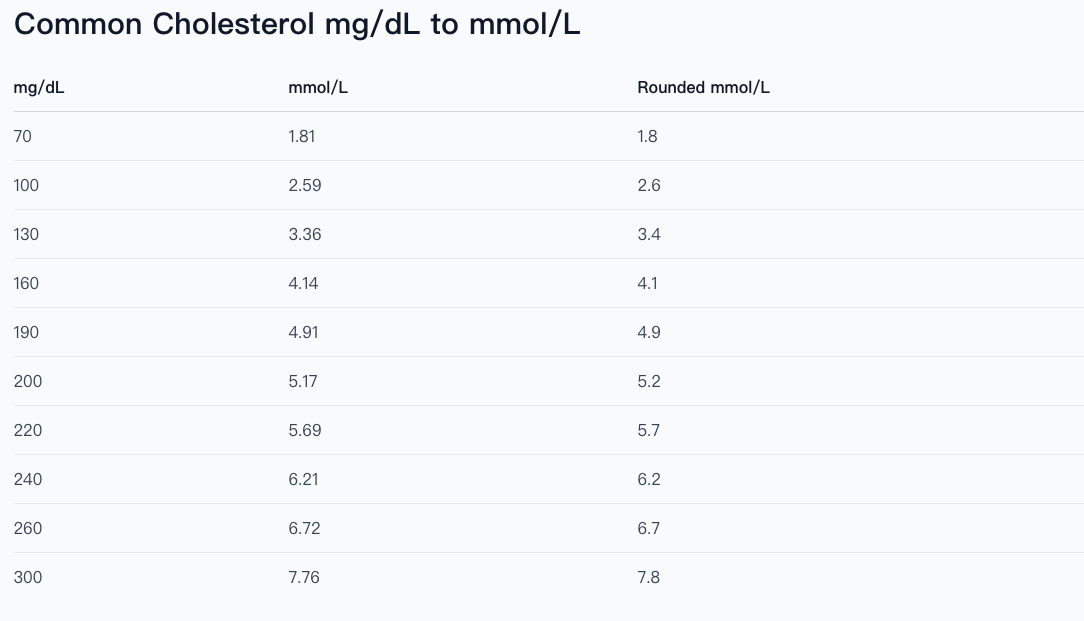
Common Cholesterol mg/dL to mmol/L
| mg/dL | mmol/L | Rounded mmol/L |
|---|---|---|
| 70 | 1.81 | 1.8 |
| 100 | 2.59 | 2.6 |
| 130 | 3.36 | 3.4 |
| 160 | 4.14 | 4.1 |
| 190 | 4.91 | 4.9 |
| 200 | 5.17 | 5.2 |
| 220 | 5.69 | 5.7 |
| 240 | 6.21 | 6.2 |
| 260 | 6.72 | 6.7 |
| 300 | 7.76 | 7.8 |
Total Cholesterol Reverse Lookup
| Total Cholesterol Category | mg/dL | mmol/L |
|---|---|---|
| Desirable | < 200 | < 5.2 |
| Borderline High | 200-239 | 5.2-6.2 |
| High | ≥ 240 | ≥ 6.2 |
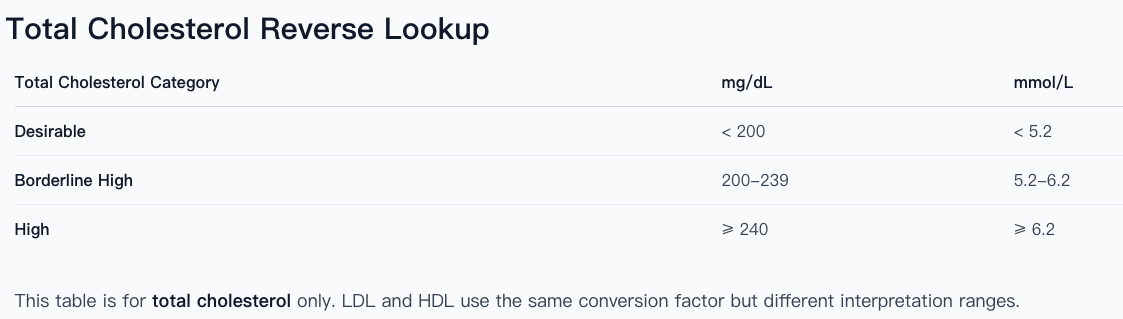
This table is for total cholesterol only. LDL and HDL use the same conversion factor but different interpretation ranges.
LDL and HDL Reverse Lookup
| Marker | mg/dL Reference | mmol/L Reference | Note |
|---|---|---|---|
| LDL optimal | < 100 | < 2.6 | LDL is often a primary risk marker |
| LDL borderline high | 130-159 | 3.4-4.1 | Interpret with risk profile |
| LDL high | 160-189 | 4.1-4.9 | Follow-up is commonly considered |
| HDL low | < 40 | < 1.0 | Low HDL is a risk factor |
| HDL high | ≥ 60 | ≥ 1.6 | Often considered favorable |
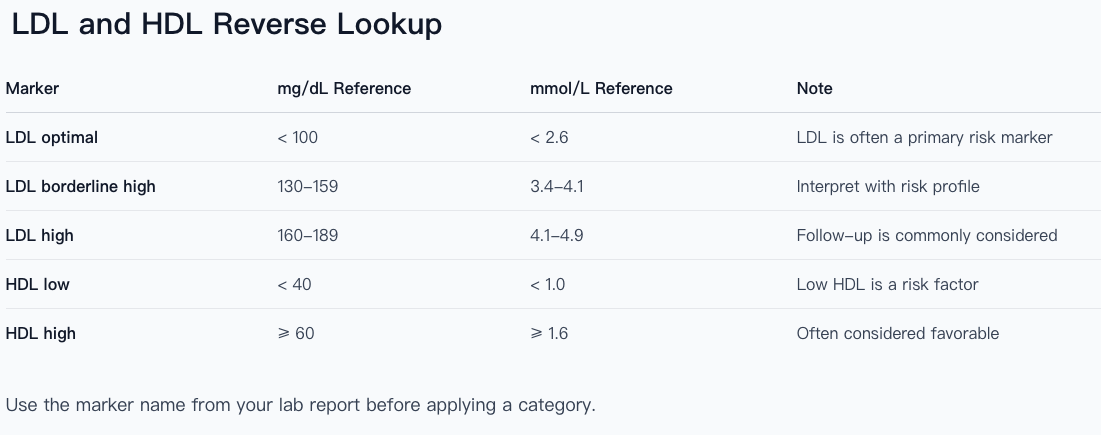
Use the marker name from your lab report before applying a category.
Which Formula Should You Use?
| Lab Marker | Use 38.67? | Correct Formula |
|---|---|---|
| Total Cholesterol | Yes | mg/dL ÷ 38.67 |
| LDL-C | Yes | mg/dL ÷ 38.67 |
| HDL-C | Yes | mg/dL ÷ 38.67 |
| Non-HDL-C | Yes | mg/dL ÷ 38.67 |
| Triglycerides | No | mg/dL ÷ 88.57 |
The most common mistake is using the cholesterol factor for triglycerides. Use Triglycerides mg/dL to mmol/L for triglyceride values.
Same Number, Different Meaning
| Value | Marker | mmol/L | Meaning Depends On |
|---|---|---|---|
| 100 mg/dL | LDL | 2.6 | LDL target context |
| 100 mg/dL | HDL | 2.6 | HDL range context |
| 200 mg/dL | Total Cholesterol | 5.2 | Total cholesterol range |
| 200 mg/dL | LDL | 5.2 | LDL range |
The unit conversion can be identical while the interpretation changes. Do not interpret a value without confirming the marker.
FAQ
What is the cholesterol mg/dL to mmol/L formula?
Use mmol/L = mg/dL ÷ 38.67 for total cholesterol, LDL, HDL, and non-HDL cholesterol.
What is 200 mg/dL cholesterol in mmol/L?
200 mg/dL ÷ 38.67 = 5.17 mmol/L, usually rounded to 5.2 mmol/L.
What is 240 mg/dL cholesterol in mmol/L?
240 mg/dL ÷ 38.67 = 6.21 mmol/L, usually rounded to 6.2 mmol/L.
What is 100 mg/dL LDL in mmol/L?
100 mg/dL ÷ 38.67 = 2.59 mmol/L, usually rounded to 2.6 mmol/L.
Does HDL use the same conversion factor as LDL?
Yes. HDL and LDL both use 38.67, but their ranges are interpreted differently.
Does this formula work for triglycerides?
No. Triglycerides use 88.57. Use the triglycerides-specific converter for triglyceride values.
Related Resources
- Cholesterol mmol/L to mg/dL - Main cholesterol conversion guide
- LDL Cholesterol mmol/L to mg/dL - LDL-specific conversion and targets
- HDL Cholesterol mmol/L to mg/dL - HDL-specific conversion and ranges
- Triglycerides mg/dL to mmol/L - Triglycerides reverse conversion
References
- Mayo Clinic. Cholesterol test
- American Heart Association. What Your Cholesterol Levels Mean
- Centers for Disease Control and Prevention. About Cholesterol
- National Heart, Lung, and Blood Institute. Blood Cholesterol
Medical Disclaimer: This page is for unit conversion and general education only. Cholesterol results should be interpreted by a healthcare professional in the context of your full lipid panel and cardiovascular risk profile.